
Hub3E vs Alternel: from a company list to a booked conversation
Hub3E now surfaces companies that recruit apprentices, so the old 'a CRM only manages what you already have' line no longer holds. But its prospecting stops at the company. It doesn't tell you which role is open today, who makes the hiring call, how to reach them, or do the reaching. That last mile is what Alternel runs.
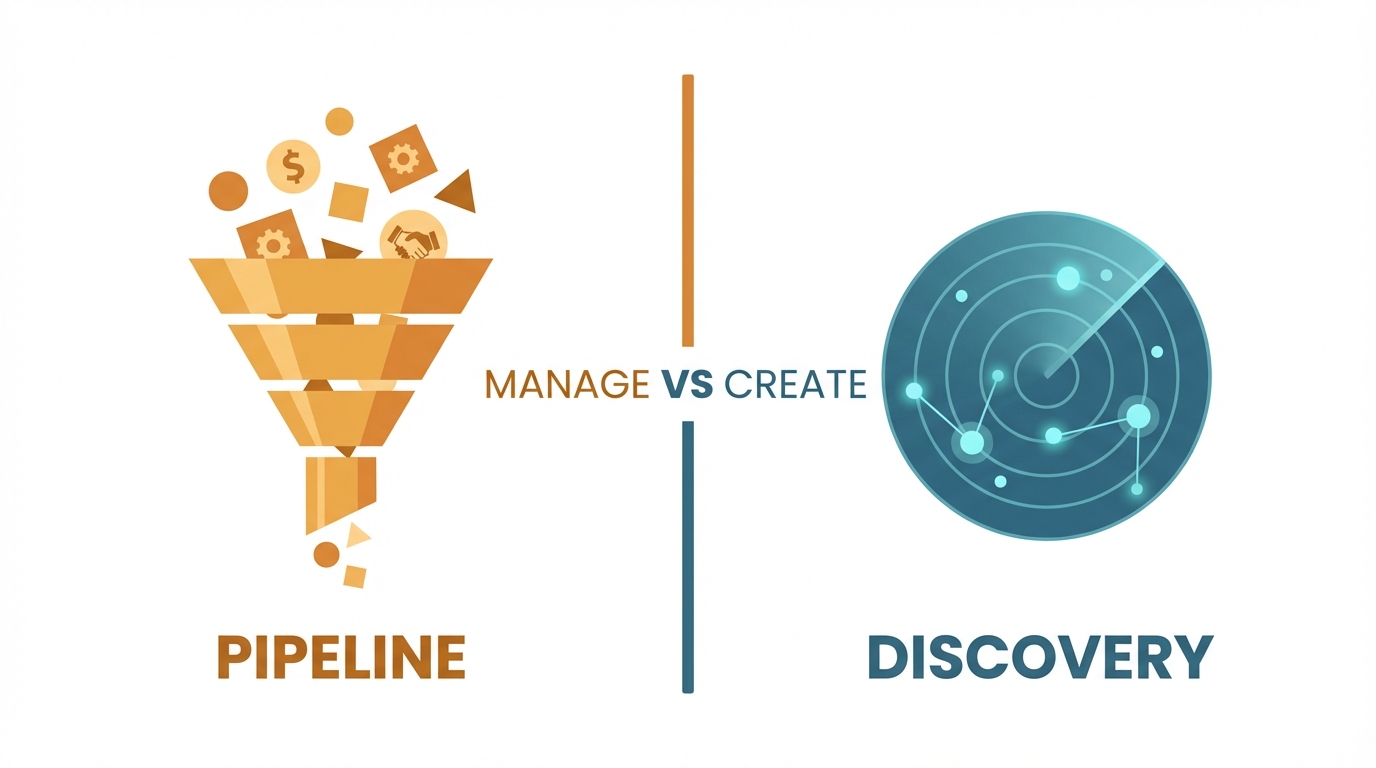
Most CFAs used to evaluate placement software by asking whether it could find new companies. Hub3E now can. So that's no longer the question that separates these two tools.
The question that matters is what happens after a company shows up on a list. Knowing that a firm somewhere recruits apprentices is the start of the work, not the end of it. Someone still has to confirm a role is open right now, find the person who actually decides, get their direct contact, and reach them before the other CFAs covering the same territory do.
That last stretch is where Hub3E and Alternel diverge, and most schools don't realize how much of the job lives there.
What Hub3E actually is
Hub3E, built by Linkpart out of Lyon and acquired in April 2025 by Adrien Vinay and a group of business angels, is the placement CRM/ATS for the tripartite alternance relationship: candidate, training center, employer. It positions itself as the number one platform for alternance. The homepage cites 200+ training centers; the acquisition announcement puts the install base at 250+ centers, with 400,000+ candidatures and 150,000 missions processed.
The core workflow runs in four stages: capture, qualify, match, place. Hub3E integrates with Yparéo, the ERP many French CFAs run for contracts and Qualiopi compliance. The feature set is real: bulk email and SMS follow-ups, a landing page builder for lead capture, RGPD-compliant data handling, dashboards tracking placements and application rates, candidate and company portals, and an AI matching algorithm that pairs candidates to company offers.
Crucially, Hub3E also ships an automated prospecting micro-service. It analyzes a center's commercial portfolio and surfaces new companies that recruit in alternance, searchable by SIRET and by trade, then sorts them into a prospect pipeline (client, new, suspect). So the comfortable story that a CRM only manages what you already have does not apply here. Hub3E goes looking for companies.
That makes the real comparison narrower, and more useful.
Where Hub3E's prospecting stops
Hub3E's prospecting works at the company level. It answers one question well: which companies recruit apprentices? It builds that answer from business-registry and firmographic data, filtered by sector and SIRET.
Everything between that list and an actual conversation is left to your team.
It doesn't scan job boards for the live signal that a placement window is open right now. A company that took an apprentice two years ago and one posting a role today look identical on a firmographic list. Knowing a firm hires in alternance in general is not the same as knowing it needs someone this month.
It doesn't identify the operational manager who will supervise the apprentice and sign off on the hire. That person is almost never named in a job ad, and never appears in a company registry.
It doesn't enrich that person's contact details: email, direct line, LinkedIn.
And it doesn't run the outreach. There's no multi-channel sequence across email, LinkedIn, and phone, and no call task pre-loaded with context for the coordinator who has to pick up the phone. The list is the deliverable. The rest is manual.
L'École by CCI Haute-Savoie flagged a related pattern in their review: Parcoursup registrations required manual re-entry because the API integration was insufficient, and the Studea integration was still under development at the time. Strong on data inside its ecosystem, weaker the moment it has to reach beyond it.
Where the 180 minutes go
A list of companies that recruit apprentices is genuinely useful. It also leaves most of the work undone.
I've watched placement coordinators run the rest by hand. With a company already identified, they still confirm a role is actually open right now (10-15 minutes), find the operational manager on LinkedIn rather than the recruiter listed on the ad (20-30 minutes), track down direct contact info (15-20 minutes), draft outreach personalized to the role and the program (20-30 minutes), and log everything back to the CRM (10-15 minutes).
That's roughly 90-130 minutes per qualified opportunity, after the company is on the list. Hub3E removes the first step, the discovery of which firms recruit apprentices at all. The longer, more skilled part of the work, turning a company into the right person contacted, still falls on the coordinator. A CFA targeting 50 new employer contacts a week is running close to a full-time job on that stretch alone.
Side by side
| Capability | Hub3E | Alternel |
|---|---|---|
| Candidate pipeline management | Full workflow | Not the focus |
| Company / employer CRM | Yes | Yes, built from outbound sourcing |
| New-company prospecting | Yes, by SIRET and trade (company level) | Yes, by live hiring signal (role level) |
| Job board scanning | Not available (uses business-registry data) | 1,000+ boards, semantic search |
| Live "hiring now" signal per role | Not available | Core function |
| Hiring manager identification | Not available | Yes, even when unlisted |
| Contact enrichment (email/phone/LinkedIn) | Not available | Yes |
| Multi-channel outreach (email + LinkedIn + calling) | Not available | Yes, automated |
| Outreach personalization | Not available | AI-personalized per role and program |
| External CRM sync (HubSpot, Salesforce, Pipedrive, Monday) | Not available | Yes |
| Call tasks with full context | Not available | Auto-created |
| ERP integration | Yparéo | Not the focus |
| Qualiopi compliance tools | Yes | Not the focus |
The two tools overlap on one row and diverge on the rest. Both prospect. Only one carries the opportunity from a name on a list to a coordinator on a call.
What changes when the last mile is automated
The gap between the two products isn't whether companies get found. It's how far the system takes each one.
Alternel starts from the live hiring signal. Semantic search across 1,000+ job boards finds roles that match your training programs, including the ones keyword search misses: non-obvious titles, companies that describe requirements in their own vocabulary, postings that never use your program's words. A role titled "assistant chef de projet opérationnel" at a logistics firm is a clean fit for a supply chain program, even though none of the title words match. That's a different input than a firmographic list: not "this company hires apprentices sometimes" but "this company is hiring this role now."
Then it finds the person. Most alternance postings list an HR mailbox or a generic recruitment address. The operational manager who will supervise the apprentice, and who makes the real decision, is almost never named. Alternel analyzes the company's structure to identify that person even when they appear nowhere in the ad. That's where the 5x improvement in contact targeting comes from: reaching the decider, not the inbox that collects CVs.
Once the contact is enriched with email, phone, and LinkedIn, outreach runs automatically, personalized to the specific role and program. Every interaction syncs to the school's CRM. Call tasks are created with full context: who to call, why the opportunity fits which program, what the AI found during qualification. Nothing depends on one coordinator being at their desk.
3x more qualified opportunities. 5x better contact targeting. 180 minutes down to 10.
Two tools, one complete process
Hub3E is the right tool for managing placement operations and for building a first list of companies that recruit apprentices. Tripartite tracking, Qualiopi compliance support, Yparéo integration, and registry-level prospecting are genuinely useful for schools that need to organize their pipeline and seed it at scale.
Alternel is the right tool for turning that pipeline into booked conversations faster than a coordinator working by hand can. It runs the last mile most CFAs still do manually across disconnected tools: live opening, decision-maker, contact, outreach.
A school using Hub3E's prospecting without an outreach layer ends up with a longer list and the same bottleneck. The constraint for most placement teams was never knowing that companies exist. It's reaching the right person at the right one before a competing school does.
The schools that win placements consistently aren't the ones with the longest prospect list. They're the ones that reach the hiring manager before the posting goes public. A list doesn't do that. The work after the list does.
We built Alternel for the placement teams that were tired of finding a good opportunity, only to discover a competing school had already called.
Sources
- Hub3E - CRM ATS logiciel alternance — Feature list and 4-stage workflow (Capter, Qualifier, Mettre en relation, Placer), capture via manual entry, landing page, or API
- Hub3E - Homepage — 200+ training centers, "plateforme n°1 de l'alternance" positioning
- Hub3E documentation - micro-services — Automated prospecting micro-service: finds new companies recruiting in alternance by SIRET and trade, sorts into a prospect pipeline; no job-board signal, hiring-manager ID, contact enrichment, or outreach
- C Birds - Cession de Linkpart, éditeur de Hub3E — April 2025 acquisition by Adrien Vinay and business angels; 250+ centers, 400,000+ candidatures, 150,000 missions; Lyon-based, ~15 employees
- Hub3E - Témoignage L'École by CCI — Integration gaps (Parcoursup manual re-entry, Studea under development), Alexandre Dorget recommendation
- Yparéo - Intégrations — Hub3E confirmed as Yparéo ecosystem partner
- Alternel — 3x opportunities, 5x targeting, 180→10 min metrics, CRM integrations, full feature set
Ready to automate CFA placement outreach?
See how Alternel finds employers, identifies decision-makers, and books conversations before the competition.